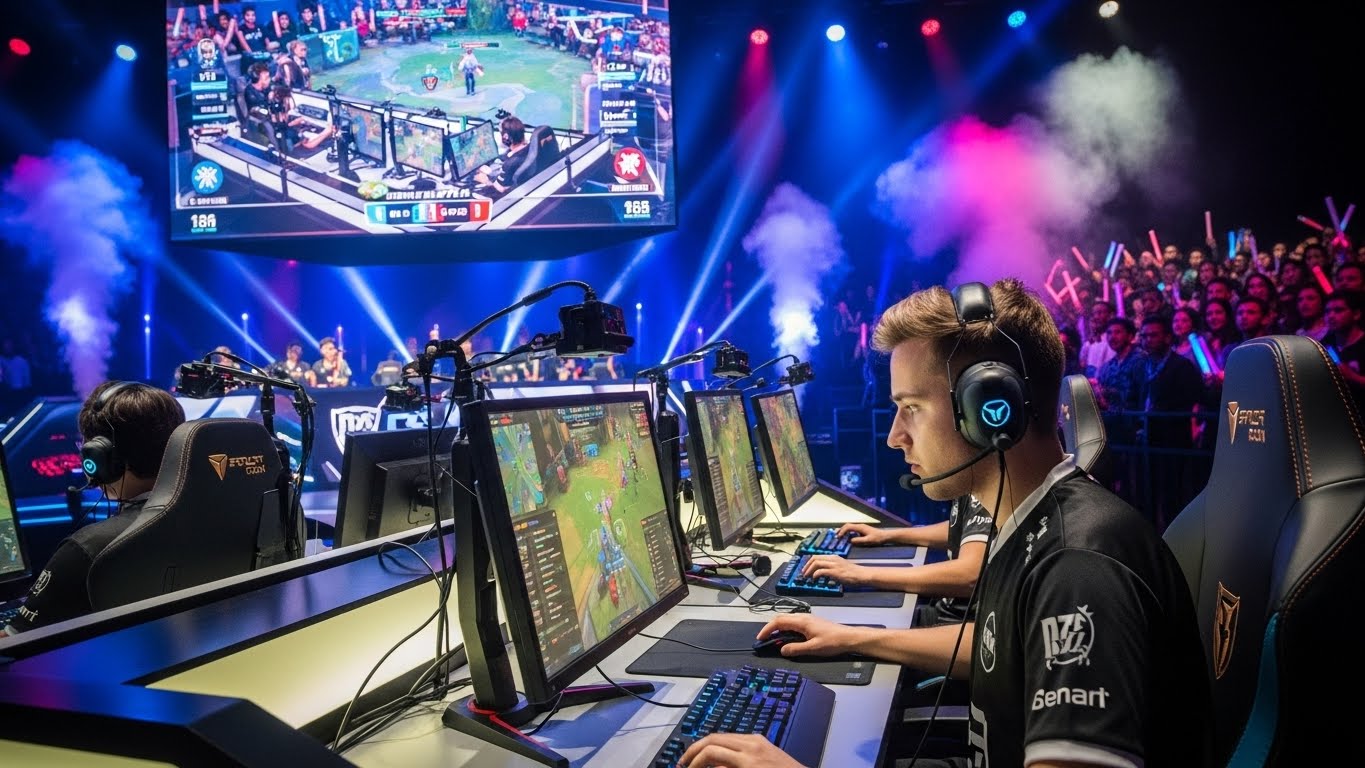
The story of esports is not a straight line. It bends and doubles back, shaped by technology cycles, shifting cultural attitudes, and the often-messy relationship between game publishers, players, and the organisations attempting to professionalise competitive play. To understand where the industry stands today requires tracing those bends with some accuracy.
The Early Days: Community Before Commerce
Competitive gaming existed long before anyone called it esports. Arcade tournaments in the early 1980s drew serious players competing for prizes, local recognition, and the particular satisfaction that comes from demonstrating mastery in a public setting. The Atari-sponsored Space Invaders championship in 1980 — often cited as one of the first large-scale competitive gaming events — drew around 10,000 participants across North America. By the standards of the time, it was remarkable.
Throughout the late 1980s and 1990s, competitive gaming remained largely decentralised. LAN parties — gatherings where players hauled their own computers or consoles to a shared venue, connected them via local area networks, and competed — became the primary format for organised competitive play. These events were communal and informal. Prizewinners might receive modest cash or hardware. The real incentive was the competition itself, and the community that formed around it.
The arrival of faster consumer internet connections in the mid-to-late 1990s began shifting competitive gaming online. Games like Quake, StarCraft, and Counter-Strike developed substantial competitive scenes that extended well beyond geography. Players in different cities and countries could now compete against each other directly, and a more interconnected global competitive ecosystem began to take shape.
The communities that formed around competitive gaming in this period weren't waiting for professional leagues or broadcast deals. They were building something because it mattered to them. That origin is worth understanding.
Korea and the Template for Professional Play
South Korea's relationship with competitive gaming in the late 1990s and early 2000s offered an early model for what professionalisation could look like. StarCraft: Brood War became the dominant competitive game in South Korea, cultivating a dedicated fanbase and a television broadcasting infrastructure that treated competitive matches as genuine sporting events. Channels like OGN and MBC Game broadcast StarCraft matches to substantial television audiences. Top players became public figures, supported by corporate sponsors and competing under structured league formats.
This Korean model demonstrated something important: competitive gaming could attract sustained viewership, produce recognisable personalities, and support a professional ecosystem in the way that traditional sports did. It didn't translate everywhere immediately — cultural context, internet infrastructure, and broadcaster appetite varied significantly by country — but it established that the audience was there if the product was compelling and accessible.

Western Esports Takes Shape
In Western markets, the growth of competitive gaming followed a different trajectory. Leagues and tournament organisations operated somewhat in parallel without a single dominant broadcast ecosystem. The Electronic Sports League (ESL), founded in Germany in 2000, became one of the more enduring organisations in this space, running competitions across multiple games. Major League Gaming in North America and various game-specific circuits each carved out portions of the competitive landscape.
What changed significantly in the early 2010s was the emergence of streaming platforms — principally Twitch, launched in 2011 — that lowered the barrier to access competitive gaming content. Viewers who couldn't attend events in person could watch live, and the combination of real-time chat and a growing streamer culture created social experiences around competitive viewing that hadn't existed in the same form before.
The International, Valve's annual Dota 2 championship, deserves particular mention. Launched in 2011, it introduced a crowdfunding mechanism that allowed fans to contribute directly to the prize pool. This model proved enormously effective. By 2019, The International's prize pool had reached over thirty million dollars, funded primarily by player community contributions. It demonstrated both the scale of player investment in competitive scenes and the economic potential of tapping that investment directly.
Riot Games and Structured League Systems
League of Legends, released by Riot Games in 2009, became central to esports' next major phase. Riot invested heavily in building a structured competitive ecosystem for the game, launching regional leagues with revenue-sharing agreements, salary standards, and eventually franchised team slots. The League Championship Series in North America and Europe, and the League Champions Korea, created year-round competitive schedules that gave teams and players consistent competitive employment.
The franchised league model, borrowed from traditional sports, was and remains controversial in esports circles. Proponents argue it provides stability for teams, players, and investors. Critics point to the high cost of buy-in, the removal of promotion and relegation, and questions about whether the model genuinely served player welfare or primarily suited team investor interests. Both arguments have merit, and the tension between them has defined much of esports governance debate over the past decade.

Player Welfare and Structural Questions
As professional competitive gaming grew, the conditions under which players operated received increasing scrutiny. Long practice hours, contract disputes, short career lifespans, and inadequate support structures for mental and physical health were documented by journalists and experienced by players publicly and privately. The average career length in competitive gaming is short — players frequently retire from top-level competition in their mid-to-late twenties.
Player unions and associations have formed in several games and regions, attempting to improve conditions and create collective bargaining frameworks. Progress has been inconsistent. Several high-profile cases of unpaid salaries, exploitative contract terms, and inadequate mental health support have prompted more organised industry responses. Some leagues now mandate minimum salaries, healthcare provisions, and other baseline conditions for team participation.
The distance between stated commitment to player welfare and on-the-ground reality varies, and independent monitoring of these commitments remains limited. This is an area where the industry still has substantial work to do, and where external journalism and community pressure have historically been more effective than internal self-regulation.
Broadcasting, Media Rights, and the Audience Question
A persistent challenge in the esports industry has been translating audience interest into sustainable media rights revenue at the scale of traditional sports broadcasting. Major sports leagues generate enormous revenues from television rights deals because broadcasters know with confidence how many people will watch. Esports viewership, while large in aggregate, has proven more difficult to monetise through traditional broadcast channels, partly because the audience skews toward streaming platforms where ad-blocking tends to be more common.
Deals with traditional broadcasters have been attempted with mixed results. The viewership numbers these deals generated were respectable but rarely transformative by the standards traditional sports media apply to rights investments. The audience relationship with esports content is different in character from traditional sports viewership, and platforms and broadcasters that have tried to apply identical models have generally found the fit imperfect.
Where Things Stand
Esports today is more professionally organised, more internationally structured, and more commercially embedded than it was even a decade ago. It is also in the middle of a period of genuine consolidation and uncertainty. Several organisations that formed during the growth years of the mid-2010s have contracted or closed. Investment that poured into team franchises has not always generated the returns investors expected on the timeline they anticipated.
None of this signals collapse. Competitive gaming has a deeply embedded audience base that has shown sustained engagement across years and platform cycles. The community infrastructure — streaming platforms, discussion forums, organised amateur play — is more developed and more stable than the professional layer above it. That base isn't going anywhere.
The questions that matter now are structural ones: how player welfare is protected as professional leagues mature, how sustainable revenue models are built without relying on the kind of speculative investment that has made some organisations fragile, and how the relationship between game publishers, team organisations, and players is governed in ways that serve the long-term health of competitive gaming rather than the short-term interests of any single actor. Those questions don't have neat answers — but the communities that built esports from the ground up are still there, and still invested in it working. That counts for something.

Marcus Chen is Editor-in-Chief at Clyvento. He has covered gaming and esports media since 2010 and contributes long-form analysis on competitive gaming structure, game design, and digital culture.